Scoliosis treatment in Dubai addresses abnormal sideways curvature of the spine through a graded approach: monitoring, physiotherapy, bracing, and corrective surgery when needed. At DRFK Turkish Medical Center in Jumeirah 3, one of a scoliosis treatment is led by Op. Dr. Fatih Kırar, a DHA-licensed spine and neurosurgery specialist with 17+ years of experience, after a scoliosis X-ray confirms the curve severity.
DRFK Turkish Medical Center is located at Villa 2, Al Athar Street, Jumeirah 3, Dubai. The clinic is easily accessible from Jumeirah, Umm Suqeim, Al Safa, Business Bay, and Downtown Dubai within around 15 minutes via Sheikh Zayed Road, with on-site parking available.
Scoliosis is a condition characterised by an abnormal sideways curvature of the spine. It can develop during childhood, adolescence, or adulthood and ranges from mild postural changes to significant spinal deformities requiring specialist care.
The cause depends on the type. Adolescent idiopathic scoliosis has no single known cause and appears during growth. Adult degenerative scoliosis develops later as discs and joints wear. Congenital scoliosis is present from birth, and neuromuscular scoliosis results from conditions affecting the muscles and nerves supporting the spine. Identifying the type and cause is the foundation of any scoliosis treatment plan.
Early signs of scoliosis are often visible before pain develops. The most common are uneven shoulders, uneven hips, a visible spinal curvature, and one shoulder blade appearing more prominent than the other.
As the curve progresses, additional symptoms can appear:
Because curves can progress silently during growth, scoliosis screening matters for adolescents even without symptoms.
Diagnosis begins with a physical examination and is confirmed with imaging. A scoliosis X-ray is the primary diagnostic tool, allowing the spine specialist to measure the curve and plan treatment.
The Cobb angle is central: it determines severity and influences whether observation, bracing, or surgery is recommended. DRFK's in-house radiology department and MRI services allow imaging and assessment within one facility in Jumeirah.
| Diagnostic Tool | Purpose |
|---|---|
| Physical examination | Detects asymmetry, rib prominence, postural imbalance |
| Scoliosis X-ray | Confirms curvature and measures the Cobb angle |
| Cobb angle measurement | Grades severity and guides treatment decisions |
| MRI | Assesses the spinal cord and soft tissue when indicated |
| CT scan | Detailed bone anatomy for surgical planning |
| Neurological evaluation | Checks nerve function in significant curves |
The Cobb angle measures the degree of spinal curvature on a scoliosis X-ray and is the key number behind every treatment decision. A smaller angle usually means observation, a moderate angle may indicate bracing during growth, and a larger angle may require corrective surgery.
Treatment is never decided on the angle alone. The spine specialist also considers patient age, skeletal maturity, symptoms, and the risk of progression, because a growing adolescent with a moderate curve carries a different risk than an adult with the same measurement.
Spinal bracing and surgery are key components of the scoliosis treatment, but they are recommended for different stages of spinal curvature. Spinal bracing is commonly used to help prevent curve progression in growing children and adolescents, while scoliosis surgery may be required for severe or progressive lumbar and thoracic cases. The most appropriate treatment is determined by the Cobb angle, scoliosis X-ray findings, symptoms, age, and risk of progression.
Most scoliosis is managed without surgery, and conservative care is the first step whenever the curve allows. Treatment recommendations depend on the degree of curvature, patient age, symptoms, and risk of progression.
Mild curves are monitored with periodic examination and a follow-up scoliosis X-ray to track whether the curve is stable or progressing.
Specialised physiotherapy, including scoliosis-specific Schroth exercises, supports posture, spinal stability, and muscle balance, and is delivered through DRFK's rehabilitation team.
For growing adolescents with moderate curves, bracing helps prevent progression while the spine matures.
For adult and lumbar scoliosis, pain management and targeted treatment address the lower back pain that often accompanies the curve.
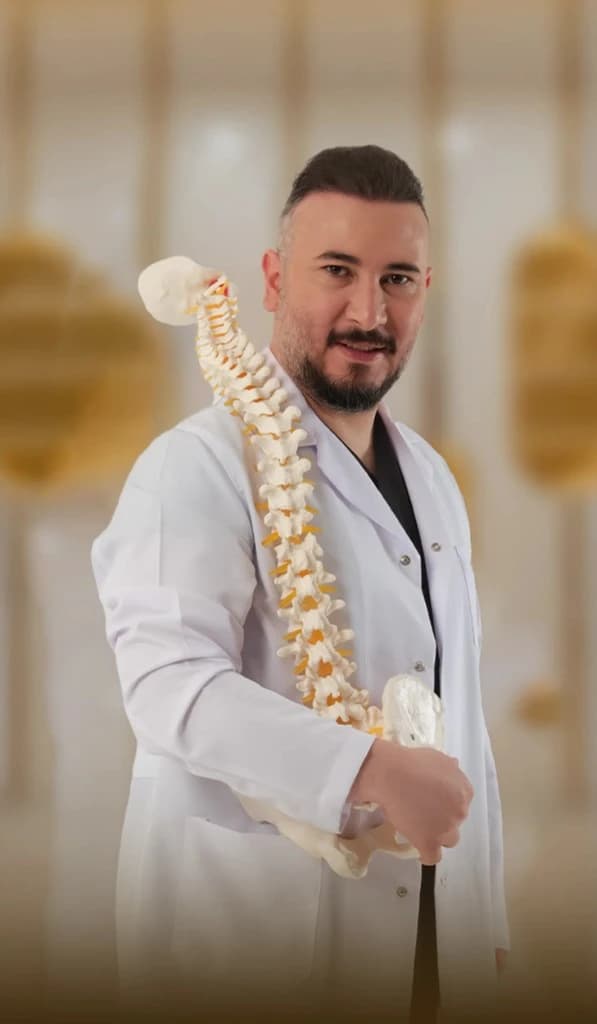
Lead specialist
Neurosurgeon, neurospine
Brain & Spine Surgery
17+ years experience
DHA License No: 20305968-001
Op. Dr. Fatih KırarScoliosis surgery is considered when the curve is severe, continues to progress despite conservative care, or affects posture, mobility, or breathing. Surgery is not the first option; it is reserved for cases where the benefit clearly outweighs the risk.
The main surgical approach is spinal fusion, which corrects and stabilises the curved segment using instrumentation. Where appropriate, minimally invasive spine surgery techniques reduce muscle disruption and shorten recovery. Op. Dr. Fatih Kırar evaluates each case individually, applying the principle that the least invasive approach that reliably achieves correction is the right one.
Recovery depends on whether treatment was conservative or surgical. Non-surgical management focuses on ongoing exercises, posture, and monitoring. After scoliosis surgery, most patients begin mobilising within days, with a structured rehabilitation medicine programme guiding return to activity over the following weeks and months.
Long-term monitoring matters in every case. Periodic review and imaging confirm the spine remains stable, particularly for adolescents still growing and adults whose curves can change with age.
Lead specialist
Neurosurgeon, neurospine
Brain & Spine Surgery
17+ years experience
DHA License No: 20305968-001
View full profileScoliosis treatment is most reliable when the same specialist handles diagnosis, surgical decision-making, and correction. At DRFK, that specialist is Op. Dr. Fatih Kırar.
As founder of DRFK Turkish Medical Center and a spine specialist recognised by patients across Dubai, Op. Dr. Fatih Kırar combines neurological precision with reconstructive capability, so scoliosis correction and neurological preservation come from a single clinician rather than a fragmented team.
Diagnosis and surgical planning are supported by a multidisciplinary team: Dr. Vivek Kapoor (Specialist Radiology, 25+ years) for scoliosis X-ray, MRI, and CT interpretation; Dr. Zahra Ghafari (Specialist Anaesthesiology) for surgical cases; and Dr. Amina Zafar (Physiotherapy & Rehabilitation) for Schroth-based and post-surgical recovery.
DRFK Turkish Medical Center is a DHA-licensed, ISO-compliant medical facility offering scoliosis diagnosis, bracing, physiotherapy, and corrective surgery under one roof in Jumeirah 3.
Clinic: DRFK Turkish Medical Center
Address: Villa 2, Al Athar Street, Jumeirah 3, Dubai, United Arab Emirates
Phone / WhatsApp: +971 4 882 1015
Email: via the contact page
Opening hours: Every day, 9:00 AM to 6:00 PM
Parking: On-site parking available
The clinic sits near Burj Al Arab and is reachable within around 15 minutes via Sheikh Zayed Road from Jumeirah 1, 2, and 3, Umm Suqeim, Al Safa, Business Bay, and Downtown Dubai. For patients searching for a scoliosis specialist or spine clinic near me in Jumeirah, DRFK offers same-week consultation appointments, in-house imaging, and international patient support, aligned with Dubai's DHA healthcare standards.
Medically reviewed by Op. Dr. Fatih Kırar, Spine & Neurosurgery Specialist, DRFK Turkish Medical Center, Jumeirah 3, Dubai.
Every day: 9:00 AM – 6:00 PM
Villa 2 Al Athar Street, Jumeirah 3, Dubai, United Arab Emirates