
Cervical spine pain treatment in Dubai at DRFK Turkish Medical Center is delivered by Op. Dr. Fatih Kırar, DHA-licensed spine and neurosurgery specialist (17+ years). DRFK provides the complete pathway for cervical spondylosis, herniated disc in the neck, cervical radiculopathy, pinched nerve, cervical stenosis, and degenerative disc disease.
DRFK Turkish Medical Center is located at Villa 2, Al Athar Street, Jumeirah 3, Dubai. The clinic is easily accessible from Jumeirah, Umm Suqeim, Al Safa, Business Bay, and Downtown Dubai within around 15 minutes via Sheikh Zayed Road, with on-site parking available.
Cervical spine pain treatment in Dubai at DRFK Turkish Medical Center is delivered by Op. Dr. Fatih Kırar, DHA-licensed spine and neurosurgery specialist (17+ years). DRFK provides the complete pathway for cervical spondylosis, herniated disc in the neck, cervical radiculopathy, pinched nerve, cervical stenosis, and degenerative disc disease.
Cervical symptoms often combine muscle strain, disc irritation, and joint overload from screens and head-forward posture. Radicular pain to the arm suggests nerve root involvement, imaging is interpreted with careful examination.
Seek immediate care for:
Sharp or burning pain, dermatomal numbness, or weakness in one arm maps to a specific disc-foraminal level. We match the story to MRI before injection or surgery, and avoid prolonged high-dose steroids or forceful manipulation when hard neuro signs are present.
The cervical spine (C1–C7) is the most mobile segment. It houses the spinal cord, supplies nerves to the arms and hands, and bears the head (~4–5 kg).
Sustained forward head posture from screen use significantly increases cervical load, at 60° of neck flexion, effective head weight increases from approximately 5 kg to 27 kg (Hansraj, 2014), explaining widespread cervical spine pain in desk-based populations.
Mechanical/postural: muscle overload, tech neck, local neck and trapezius pain without arm symptoms, physiotherapy and posture correction.
Degenerative: spondylosis, disc degeneration, osteophytes, facet arthrosis, physiotherapy, laser, facet injection.
Neurological (radiculopathy/myelopathy): disc, spur, or foraminal stenosis compressing roots or cord, targeted injection or surgical decompression.
Most common chronic cervical pain over 40, physiotherapy (primary), laser, traction, facet injection for facet-mediated pain.
Stepped pathway: physiotherapy and laser → cervical epidural → ACDF or disc replacement when conservative care fails.
C5/C6 (lateral arm, thumb), C6/C7 (posterior arm, middle finger) dermatomal patterns. NCS/EMG confirms level. Epidural effective in majority; ACDF for progressive deficit or injection failure.
Selective nerve root block confirms level and relieves symptoms when multi-level MRI makes clinical localisation uncertain before surgery.
Mild cases: physiotherapy. Progressive myelopathy (gait change, bilateral hand weakness, bladder dysfunction): urgent surgical assessment.
Acute onset bilateral weakness or bladder dysfunction from cervical myelopathy: call 999 or attend emergency services immediately. Progressive myelopathy: urgent specialist referral within 24 hours.
Chronic axial pain and segmental instability, core cervical stabilisation, laser, fusion when instability confirmed.
Herniated disc → compresses cervical nerve root → dermatomal arm pain, numbness, weakness.
C5/C6: lateral arm and thumb. C6/C7: posterior arm and middle finger. C7/T1: medial arm and little finger.
Op. Dr. Fatih Kırar matches clinical examination to MRI before treatment, treating the wrong level produces no benefit.
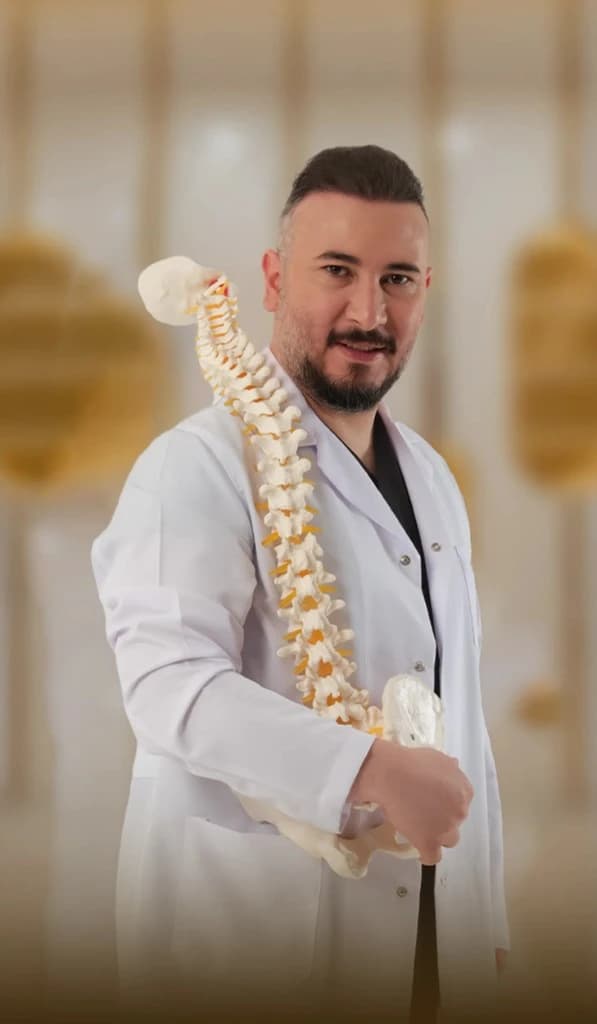
Lead specialist
Neurosurgeon, neurospine
Brain & Spine Surgery
17+ years experience
DHA License No: 20305968-001
View full profile| Diagnostic tool | Application |
|---|---|
| MRI cervical spine | Disc herniation, root compression, cord signal, stenosis |
| CT cervical spine | Bone spur, foraminal narrowing, fracture |
| Standing cervical X-ray | Alignment, disc height, flexion-extension instability |
| NCS / EMG | Root level and severity, before injection or surgery |
| MRI brain | Excludes intracranial causes when headache or coordination symptoms present |
Decision flow: Mechanical/postural → physiotherapy + posture | Degenerative → physio + laser + injection | Radiculopathy → injection + physio | Myelopathy → urgent surgery
Dr. Amina Zafar, deep cervical flexor strengthening, scapular stabilisation, cervical mobilisation, postural correction, neural mobilisation, trigger point therapy, ergonomic assessment.
Candidates: mechanical pain, postural pain, early disc without progressive neurology, mild radiculopathy. Expected improvement 4–8 weeks. Choose over injection when neurology absent or mild.
Mechanical or manual distraction, adjunct for foraminal stenosis with arm symptoms.
Reduces disc and facet inflammation, 3–6 sessions for measurable relief; full course 8–12 sessions.
Performed by Op. Dr. Fatih Kırar under fluoroscopic guidance. Best for radiculopathy with arm pain. Relief 3–14 days; effect 4–12 weeks. Choose over surgery when no progressive neurology.
Performed by Op. Dr. Fatih Kırar, level-specific diagnostic and therapeutic injection when multi-level MRI obscures clinical level before surgery.
Performed by Op. Dr. Fatih Kırar, facet syndrome confirmation; RFA for 12–24 months relief. Best for axial pain worsened by extension/rotation without arm radiation.
Options: ACDF (gold standard for disc with myelopathy or persistent radiculopathy), cervical artificial disc replacement (selected single-level), laminoplasty/laminectomy (multi-level stenosis).
| Treatment | Condition | Nerve decompression | Recovery |
|---|---|---|---|
| Physiotherapy | Mechanical, postural, tech neck | No | 4–8 weeks |
| Laser therapy | Disc, facet, whiplash | No | Immediate/ongoing |
| Cervical traction | Foraminal stenosis + radiculopathy | Indirect | During course |
| Cervical epidural | Radiculopathy, disc with arm pain | Indirect | 1–2 days |
| Nerve root block | Level-specific radiculopathy | Indirect | 1–2 days |
| Cervical RFA | Chronic facet syndrome | No | 3–5 days |
| ACDF | Myelopathy, persistent radiculopathy | Yes, direct | 3–6 weeks |
| Disc replacement | Single-level, motion preservation | Yes, direct | 2–4 weeks |
| Laminectomy / laminoplasty | Multi-level stenosis + myelopathy | Yes, direct | 4–8 weeks |
| Treatment | Pain relief | Desk return | Full activity |
|---|---|---|---|
| Physiotherapy | 4–8 weeks | Week 1 modified | 8–12 weeks |
| Laser therapy | 3–6 sessions | Immediate | Ongoing |
| Cervical epidural | 3–14 days | 1–2 days | 1–2 weeks |
| Nerve root block | Days–2 weeks | 1–2 days | 1–2 weeks |
| Cervical RFA | 2–4 weeks | 3–5 days | 2–4 weeks |
| ACDF | 3–6 weeks | 3–6 weeks | 8–12 weeks |
| Disc replacement | 2–4 weeks | 2–4 weeks | 6–8 weeks |
Lead specialist
Neurosurgeon, neurospine
Brain & Spine Surgery
17+ years experience
DHA License No: 20305968-001
Op. Dr. Fatih Kırar, Full profileDHA-licensed spine and neurosurgery, 17+ years. Cervical disc, radiculopathy, myelopathy, and fluoroscopy-guided injections.
Cost depends on treatment selected. Physiotherapy, laser, and clinically indicated injections covered by most UAE plans. Surgical pre-authorisation managed by our team.
MRI/CT and NCS when indicated, level-matched care.
Dr. Amina Zafar, deep neck flexors, scapular control, workstation set-up.
Inflammation control and foraminal relief adjuncts.
Epidural, nerve root block, facet/RFA, Op. Dr. Fatih Kırar.
ACDF, artificial disc, laminoplasty when criteria met.
Staged return to load and sport.
Screen at eye level; avoid chin-on-chest phone use
Balance bag load, avoid one-shoulder slouch
Stop high-velocity neck manipulation if arm numbness present
Hold phone at eye level; break screen time every 20 minutes
Report progressive weakness or bladder change immediately
Medically reviewed by Op. Dr. Fatih Kırar | DRFK Turkish Medical Center, Jumeirah 3, Dubai | Last updated: April 2026
Every day: 9:00 AM – 6:00 PM
Villa 2 Al Athar Street, Jumeirah 3, Dubai, United Arab Emirates