Breast augmentation is a cosmetic breast surgery procedure designed to increase breast volume and improve proportions using implants or, in selected cases, fat transfer. Treatment planning considers anatomy, breast tissue, implant selection, and long-term goals to achieve balanced, natural-looking outcomes. At DRFK Turkish Medical Center, Jumeirah 3, surgery is performed by Dr. Ece Kalafatlar Gül, FEBOPRAS-certified Plastic Surgeon.
DRFK Turkish Medical Center is located at Villa 2, Al Athar Street, Jumeirah 3, Dubai. The clinic is easily accessible from Jumeirah, Umm Suqeim, Al Safa, Business Bay, and Downtown Dubai within around 15 minutes via Sheikh Zayed Road, with on-site parking available.
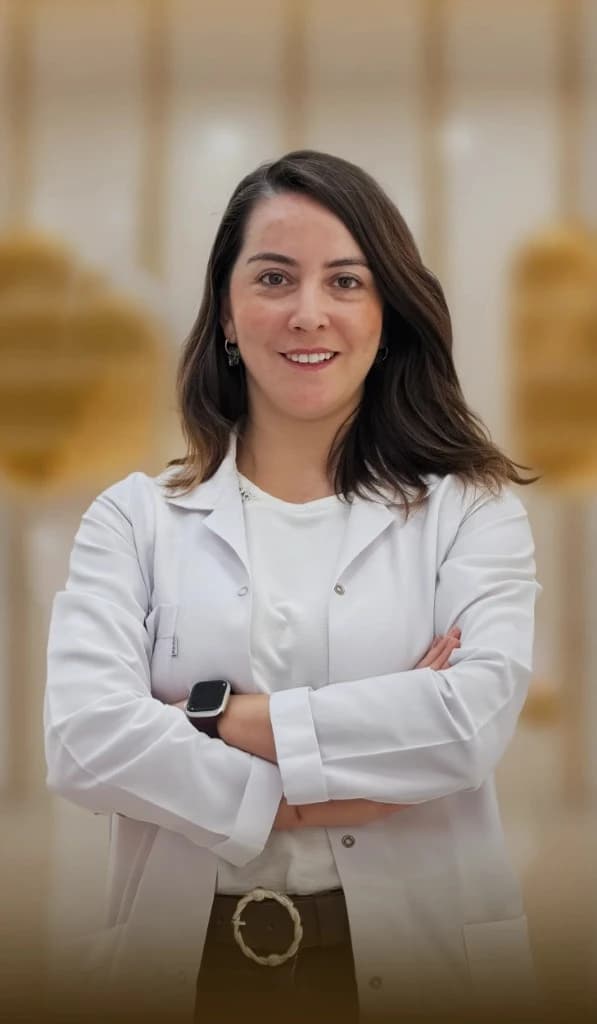
Lead specialist
Specialist in Plastic, Reconstructive & Aesthetic Surgery
Plastic & Aesthetic Surgery
12+ years experience
Dr. Ece Kalafatlar GülBreast volume and shape change because of pregnancy, breastfeeding, weight loss, and aging, all of which affect breast tissue and skin. Pregnancy and breastfeeding can leave reduced fullness, weight loss decreases volume, and aging reduces skin elasticity and upper pole fullness.
These changes explain why women consider breast enlargement at different life stages. Some seek restoration of lost volume, others correction of asymmetry or naturally small breast volume. Identifying the underlying reason guides implant selection and whether a breast lift may also be needed, which Dr. Ece Kalafatlar Gül assesses at consultation.
Implant selection involves evaluating chest width, breast tissue characteristics, skin elasticity, body proportions, and treatment goals. The surgeon considers these anatomical factors to determine an implant size and profile that supports balanced proportions while maintaining a natural relationship between the chest wall and breast shape.
Breast implants vary by material, shape, and profile.
Rather than choosing by size alone, Dr. Ece Kalafatlar Gül matches implant characteristics to anatomy so the result suits the patient's frame.
| Implant Factor | Options |
|---|---|
| Material | Silicone gel, saline |
| Shape | Round, anatomical (teardrop) |
| Profile | Low, moderate, high projection |
| Surface | Smooth, textured |
Implants are placed either above the chest muscle (subglandular) or partly beneath it (submuscular or dual plane), and the choice affects how natural the result looks and feels. Placement depends on existing breast tissue, skin coverage, and the implant selected.
Patients with more natural tissue coverage may suit one approach, while those with less coverage often benefit from partial muscle coverage for a smoother, more natural upper pole. This decision is part of surgical planning, balancing appearance, feel, and long-term outcome.
Fat transfer breast augmentation uses the patient's own fat, harvested by liposuction and purified, to add modest volume without implants. It suits patients seeking a small, natural increase who also want fat reduced elsewhere, rather than a significant size change.
It has limits: the volume increase is modest and some transferred fat is reabsorbed. For larger volume or specific shaping, breast implants remain more predictable. Dr. Ece Kalafatlar Gül explains which approach realistically matches the patient's goals.
Yes. When breast sagging accompanies volume loss, augmentation can be combined with a breast lift (mastopexy), since implants restore volume but do not lift significantly drooping breasts. Combining the two restores both fullness and position in one procedure.
Whether a lift is needed depends on nipple position and the degree of sagging, assessed during planning. Adding volume alone to a sagging breast can look unnatural, which is why honest assessment matters.
Breast augmentation is performed under general anaesthesia, and recovery progresses over weeks. Most patients resume light activity within days to a couple of weeks, with strenuous activity and exercise delayed longer on the surgeon's guidance, supported by a surgical bra.
Breast implants are durable but not lifetime devices. Longevity varies with implant type, anatomy, and tissue changes, and regular follow-up monitors implant condition and breast health. Some patients later consider implant exchange or revision surgery based on personal goals or clinical findings.
DRFK Turkish Medical Center is a DHA-licensed, ISO-compliant facility in Jumeirah 3 with hybrid operating suites, specialist anaesthesia, and structured recovery for cosmetic breast surgery. Surgical planning uses calibrated photography and implant planning to support balanced proportions, with follow-up built into care.
The clinic serves patients from Jumeirah, Umm Suqeim, Al Safa, Al Wasl, City Walk, Business Bay, Downtown Dubai, DIFC, Dubai Marina, Palm Jumeirah, JBR, Emirates Hills, Dubai Hills, and Arabian Ranches, with multilingual support for international patients. Surgery is performed by Dr. Ece Kalafatlar Gül, FEBOPRAS-certified Plastic Surgeon and ISAPS member.
Medically reviewed by Dr. Ece Kalafatlar Gül, FEBOPRAS Plastic Surgeon, DRFK Turkish Medical Center, Jumeirah 3, Dubai.
Every day: 9:00 AM – 6:00 PM
Villa 2 Al Athar Street, Jumeirah 3, Dubai, United Arab Emirates