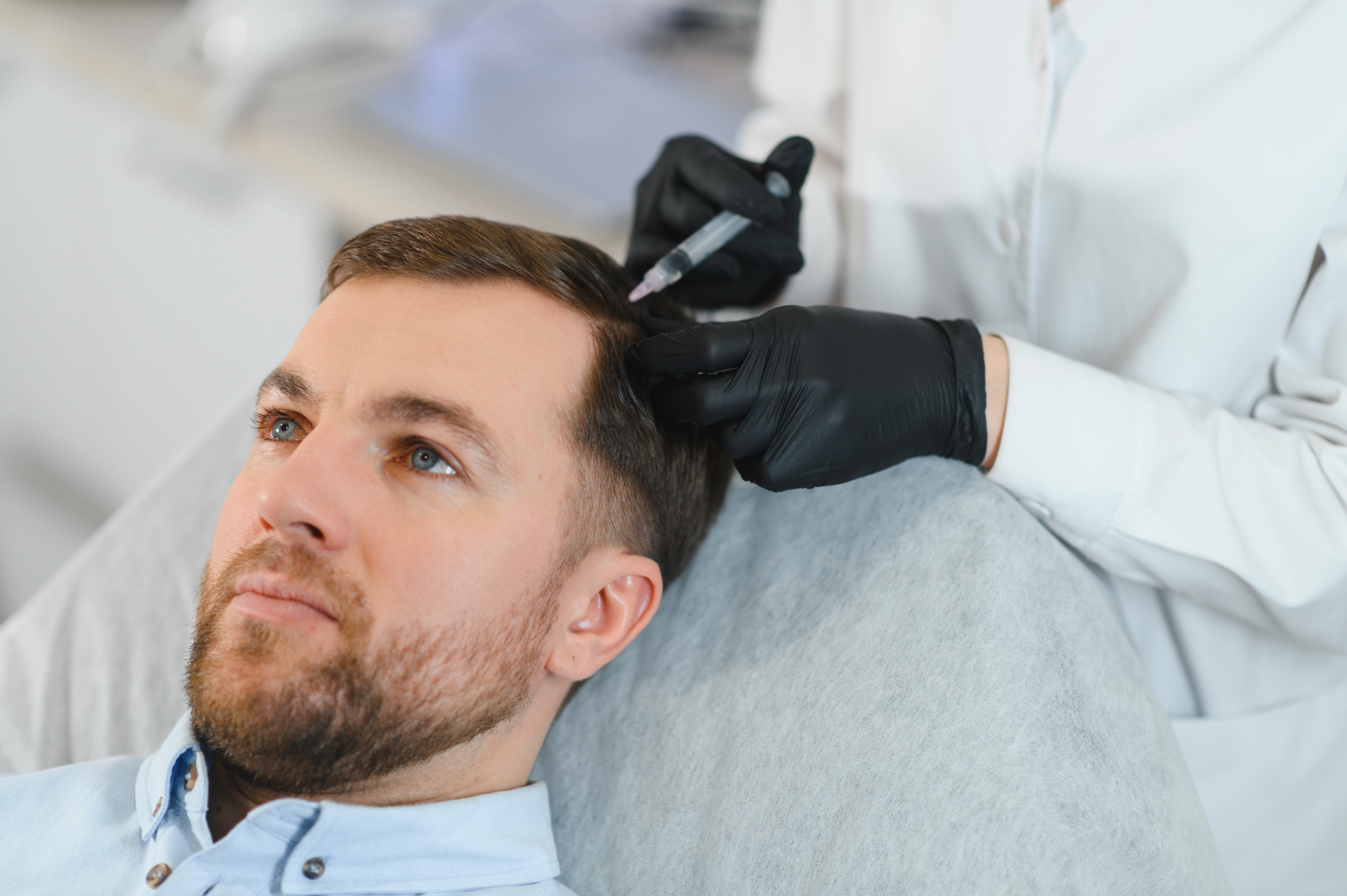
Sapphire (ceramic) blades can make recipient sites with fine control of depth and width on suitable scalp skin, useful when the plan calls for dense, regular incisions. At DRFK the technology is offered where it fits your skin type and surgeon workflow; it does not replace judgment on angle, depth, or graft spacing.
DRFK Turkish Medical Center is located at Villa 2, Al Athar Street, Jumeirah 3, Dubai. The clinic is easily accessible from Jumeirah, Umm Suqeim, Al Safa, Business Bay, and Downtown Dubai within around 15 minutes via Sheikh Zayed Road, with on-site parking available.
Recipient sites may be created with a sharp, consistent edge that some teams prefer for certain densities and hair calibre. Healing and crusting patterns still follow your biology and aftercare, the blade is not a shortcut to faster growth.
Donor extraction remains follicular unit FUE; sapphire addresses the recipient side. Graft survival depends on handling time, hydration, and placement technique, areas where team experience matters more than the knife label.
Sapphire FUE is an advanced FUE technique in which the recipient-site micro-channels are created using sapphire crystal (corundum) blades rather than conventional steel micro-blades. The sapphire blade's molecular smoothness and rigidity allows V-shaped channels at sub-millimetre precision, producing smaller, more uniform recipient sites that minimise scalp trauma, reduce bleeding, accelerate healing, and allow closer graft spacing for higher density per cm².
Core mechanism: Sapphire blade → creates V-shaped micro-channel → smaller incision than steel blade → allows closer graft spacing → higher density per cm² → minimal tissue trauma → faster healing → less scabbing → improved graft survival rate.
The sapphire blade does not replace FUE extraction, follicular units are still extracted by micro-punch from the donor area. Sapphire refers specifically to the channel creation phase, the step that determines graft survival, final density, and healing speed.
Standard FUE uses surgical-grade steel micro-blades. Steel blades produce a slightly wider and more irregular channel, requiring more tissue displacement and causing more micro-trauma to surrounding capillaries.
Sapphire crystal is harder than steel, molecularly smoother, and self-sharpening in use, producing a cleaner, finer V-shaped incision with less lateral tissue distortion. Result: Sapphire channel → less bleeding → less oedema → less scabbing → visible primary healing in 5–7 days versus 7–14 days for standard FUE.
Standard blade channels create a linear slit. Sapphire blades create a V-shaped channel, the angled walls stabilise the inserted graft without suture, maintaining correct angle and direction as it heals.
The V-shape also allows closer channel spacing, the fundamental limitation on graft density is the minimum safe distance between adjacent channels. Smaller, more precise V-shaped channels can be placed closer together, producing higher graft density per cm² and overall hair coverage.
Sapphire FUE is an advanced evolution of standard FUE, producing measurable improvements in density, healing, and graft survival.
| Feature | Sapphire FUE | Standard FUE |
|---|---|---|
| Blade material | Sapphire crystal | Surgical steel |
| Channel shape | V-shaped | Linear slit |
| Channel precision | Higher | Standard |
| Graft density achievable | Higher | Standard |
| Tissue trauma | Less | More |
| Bleeding | Minimal | Mild |
| Healing speed | 5–7 days primary | 7–14 days |
| Scabbing | Less | More |
| Graft survival rate | Higher | Standard |
| Pain during recovery | Less | Standard |
Sapphire FUE pre-creates all recipient channels before grafts are implanted, the surgeon controls channel depth, angle, and direction with the sapphire blade, then grafts are placed into the pre-created sites.
DHI creates each channel and implants the graft simultaneously, no pre-created channels. DHI offers maximum precision at the individual graft level; sapphire FUE offers maximum density engineering across the entire recipient zone.
At DRFK, the choice is determined by the patient's primary need, larger-zone density coverage (sapphire FUE) versus hairline precision work (DHI), or a combination of both for comprehensive restoration.
| Assessment | Purpose |
|---|---|
| Norwood Scale Grading | Hair loss severity, graft requirement calculation |
| Donor Density Trichoscopy | Occipital follicle density, confirms graft availability |
| Recipient Zone Mapping | Priority zones, hairline, mid-scalp, crown, density distribution plan |
| Scalp Elasticity Assessment | Confirms scalp suitable for sapphire channel creation |
| Sapphire vs DHI Decision | Anatomy-based technique selection |
Follicular units extracted from the occipital donor area using 0.6–0.9mm micro-punch, identical to standard FUE. Grafts sorted under microscope, single-hair units for hairline edge; two and three-hair units for mid-scalp density.
The surgeon creates recipient-site channels using the sapphire crystal blade, systematically mapping the hairline and density zones. Each channel is created at the precise angle, direction, and depth calculated for that scalp location. V-shaped sapphire incisions are placed at the minimum safe density, significantly higher than standard blade technique allows.
Hairline design: The hairline zone receives single-hair grafts in micro-irregular channels, the natural irregular pattern of a biological hairline rather than a straight line. Temple points reconstructed with the same design.
Grafts are placed into the pre-created sapphire channels, stabilised by the V-shaped walls without suture. The Choi pen is sometimes used for the hairline edge in hybrid sessions, combining sapphire density engineering with DHI hairline precision.
| Step | What Happens |
|---|---|
| 01, Consultation | Norwood grading, donor assessment, sapphire vs DHI decision |
| 02, Scalp shaving | Donor + recipient zones |
| 03, Local anaesthesia | Donor and recipient scalp |
| 04, FUE extraction | Micro-punch donor harvesting |
| 05, Sapphire channel creation | Density mapping, angle control |
| 06, Graft implantation | Single hairs at hairline, multi-hair units for density |
| 07, Post-op | Instructions and first wash protocol |
| Phase | Timeline | Sapphire FUE Advantage |
|---|---|---|
| Primary Healing | Days 1–5 | Faster than standard FUE, scabs resolve Days 5–7 |
| Shock Loss | Weeks 2–8 | Same as all FUE, shedding is normal |
| Early Regrowth | Months 3–4 | Consistent with FUE timeline |
| Density Development | Months 4–6 | Higher density visible earlier due to channel spacing |
| Full Result | Months 9–12 | Final sapphire FUE density result |
Thickness, scarring, and prior surgery influence whether fine blades are ideal.
Grafts placed immediately per team protocol; avoid sun and trauma in the early week as directed.
Avoid smoking and nicotine for the full period your team recommends before and after surgery, both reduce graft survival and wound healing.
Bring a complete medication and supplement list (including blood thinners) and report any prior scalp surgery or medical scalp treatments at pre-assessment.
Plan social and work buffer time: visible redness or crusting in weeks 1–2 is normal; many patients schedule lighter commitments during early healing.
Every day: 9:00 AM – 6:00 PM
Villa 2 Al Athar Street, Jumeirah 3, Dubai, United Arab Emirates