Female pattern hair loss, temporal recession, and density loss after trauma or surgery, with hormone review (e.g. PCOS, thyroid) when the pattern suggests it, and trichoscopy to separate miniaturisation from scarring alopecia. DRFK designs soft, low hairlines and avoids harsh “strip” angles when a feminine frame is the goal; mega-session size stays within safe donor numbers.
DRFK Turkish Medical Center is located at Villa 2, Al Athar Street, Jumeirah 3, Dubai. The clinic is easily accessible from Jumeirah, Umm Suqeim, Al Safa, Business Bay, and Downtown Dubai within around 15 minutes via Sheikh Zayed Road, with on-site parking available.
Scarring alopecia, active dermatitis, or rapid diffuse shedding can need biopsy or treatment before transplant. We will not place grafts into unstable inflammatory scalp without a clear diagnosis.
Finer single-hair grafts at the hairline, gradual density transitions, and discussion of parting style matter for long-hair plans, your styling preferences are in the pre-op session.
Hair transplant for women requires a fundamentally different clinical approach than male hair transplantation, because female hair loss has different causes, different patterns, different donor characteristics, and different design requirements. The most significant difference: most women with hair loss are NOT ideal transplant candidates. Diffuse female hair loss often affects the donor area as much as the recipient, transplanting diffuse donor follicles produces grafts that will miniaturise and shed in the new location. Donor assessment is the critical first step at DRFK, not assumed candidacy.
Female hair loss (FPHL/Ludwig pattern): Thinning is typically diffuse, affecting the crown and mid-scalp while preserving the frontal hairline, in contrast to the male Norwood recession pattern. Transplant candidates must have a stable, sufficient-density donor area, confirmed by trichoscopy.
Female pattern hair loss (FPHL): Androgen-sensitive follicle miniaturisation producing Ludwig grade I–III diffuse crown thinning. FPHL is correctable by transplant when the donor area is DHT-resistant and stable. Medical management (minoxidil, spironolactone, finasteride off-label) must be optimised before transplant.
Traction alopecia: Mechanical follicle destruction from chronic tension hairstyling, tight braids, weaves, ponytails producing a characteristic bandlike hairline recession. Highly correctable by transplant when causative styling has been discontinued for 6–12 months.
Hairline design restoration: Naturally high hairlines, post-surgical hairline distortion, or temple recession producing an unfeminine forehead-to-hairline ratio, correctable with DHI single-hair implantation using feminine hairline design principles.
Post-trauma or scar alopecia: Burns, surgical scars, or post-injury follicle destruction, correctable when scarred skin retains adequate vascularity for graft survival.
PCOS (polycystic ovary syndrome): Androgen excess triggers follicle miniaturisation in androgenetically sensitive women, producing male-pattern-like thinning that responds to anti-androgen therapy (spironolactone). PCOS must be medically managed before transplant.
Postpartum telogen effluvium: Post-delivery oestrogen drop triggers synchronised shedding at 2–4 months post-birth. This is temporary and self-resolving in 6–12 months. Postpartum hair loss is NOT a transplant indication. DRFK delays transplant assessment 12 months post-partum.
Menopause-related hair thinning: Oestrogen decline progressively unmasks androgen sensitivity, diffuse thinning from the 50s. HRT may slow the process; transplant requires donor stability confirmation.
Female FPHL follows the Ludwig scale: Grade I (central parting widening), Grade II (diffuse crown thinning), Grade III (extensive crown loss), with the frontal hairline typically preserved.
Unlike male androgenetic alopecia where the occipital donor area is consistently DHT-resistant, female FPHL frequently miniaturises diffusely, including the donor area. Transplanting miniaturised donor follicles produces grafts that continue to thin in the new location.
At DRFK, trichoscopy of the donor area is performed before any transplant recommendation. Women with diffuse donor miniaturisation are directed to medical management and PRP, not surgery.
Women who ARE good transplant candidates: Stable donor area with normal density on trichoscopy. Localised hair loss (traction, scar alopecia). Hairline advancement with minimal diffuse thinning. Ludwig Grade I–II with confirmed stable, dense occipital donor.
| Assessment | Purpose |
|---|---|
| Ludwig Scale Classification | FPHL severity grading, I (mild), II (moderate), III (severe) |
| Trichoscopy, Donor Assessment | Critical: confirms DHT-resistance of donor area, determines candidacy |
| Hormonal Blood Panel | FSH, LH, testosterone, DHEAS, thyroid, ferritin, prolactin |
| Scalp Analysis | Miniaturisation ratio in recipient vs donor, candidate determination |
| Dermatology / Trichology Review | Rules out alopecia areata, inflammatory scalp disease |
| Hairline Design Assessment | Feminine hairline proportion analysis, height, temporal zone, soft design |
Standard FUE requires shaving the recipient area, visibly exposing the thinning scalp during recovery. Unshaved FUE for women shaves only the donor area (concealed under surrounding hair) and leaves recipient hair intact. Grafts are implanted between existing hairs.
Best for: Women with partial diffuse thinning who cannot tolerate the social exposure of a fully shaved scalp.
DHI's most valuable feature for female transplant: implanting into an unshaved recipient zone, the Choi pen is guided between existing hairs without pre-created channels. Only the donor area is shaved, concealed under surrounding longer hair. Women can attend normal social and professional schedule within days of surgery with minimal visible change.
Best for: Hairline restoration, partial thinning densification, traction alopecia correction, any case where recipient shaving is unacceptable.
Male and female hairlines are anatomically different. The design failure of applying masculine hairline geometry to female transplant produces unnatural results.
Feminine hairline characteristics: Softer frontal contour, a gentle rounded arc rather than the flatter male hairline. Lower central peak, the Widow's peak is softer or absent. Softer temporal recession, females retain more temporal hair. Ethnic hairline mapping, Middle Eastern women have specific proportions distinct from other templates. Density gradient, soft transition from hairline to mid-scalp.
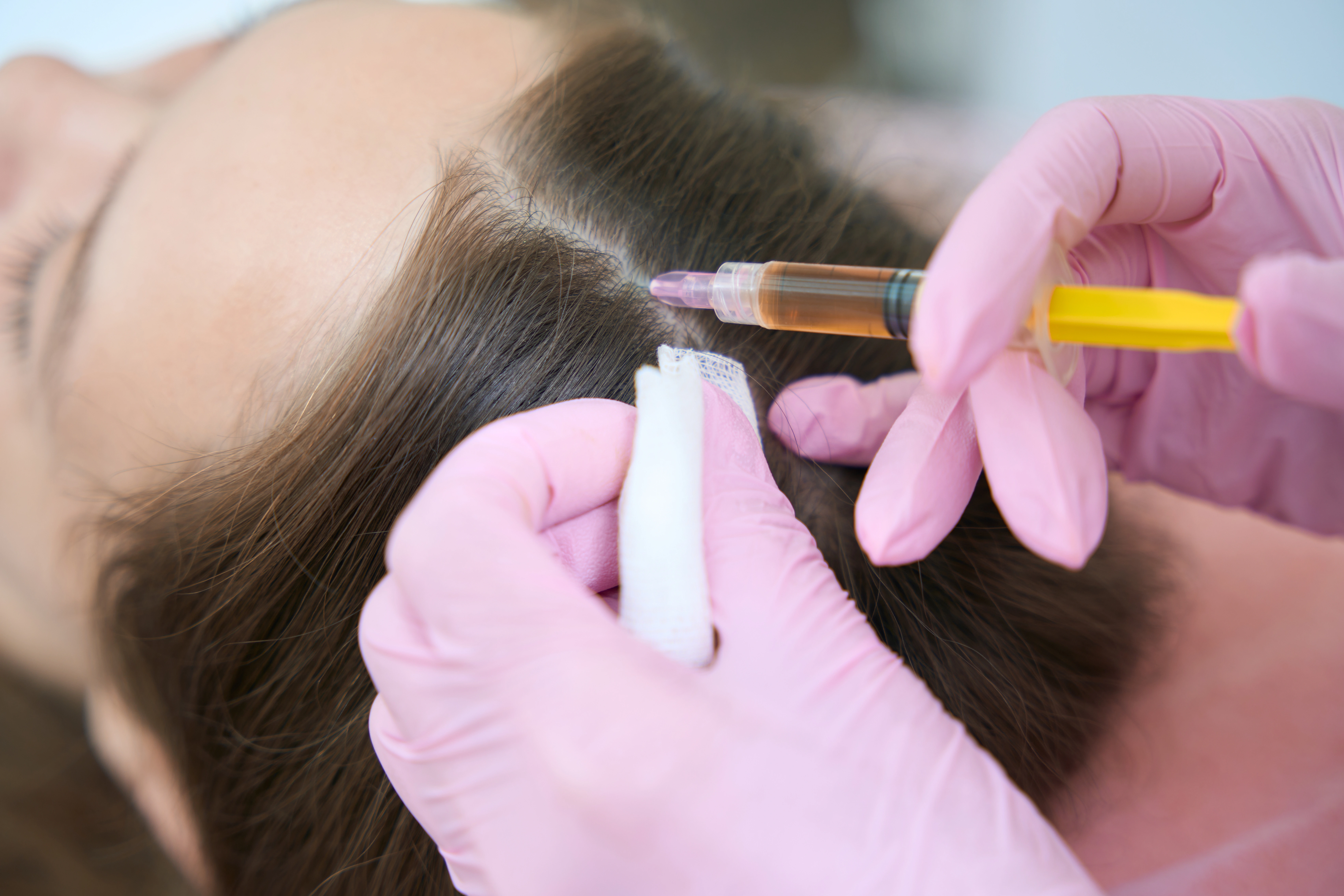
Platelet-rich plasma (PRP) therapy, injections of concentrated autologous growth factors, stimulates follicular activity, prolongs the anagen phase, and reduces miniaturisation in early FPHL cases where donor trichoscopy shows insufficient stable donor density for transplant.
PRP is offered at DRFK as: Standalone treatment for non-surgical candidates. Post-transplant adjunct to support graft survival and stimulate surrounding native follicles.
| Step | What Happens |
|---|---|
| 01, Consultation | Ludwig grading, hormonal blood panel, donor trichoscopy |
| 02, Medical optimisation | If hormonal cause identified, treat before transplant |
| 03, Transplant clearance | Stable donor confirmed; candidacy approved |
| 04, Pre-op | Donor shaving (concealed); recipient: unshaved option assessed |
| 05, Extraction | FUE or DHI technique selected per anatomy |
| 06, Feminine hairline design | Marked and confirmed before implantation |
| 07, Implantation | Soft feminine hairline, correct angle and direction |
| 08, Post-op | Written care protocol; shock loss education; Day 10 and Month 3 follow-up |
The shock loss phase in women: Particularly important to pre-educate female patients, transplanted hairs shedding at Weeks 2–8 can be more distressing when hair loss is already an emotionally significant concern. At DRFK, every female patient receives detailed written and verbal shock loss education before surgery.
| Phase | Timeline | Female-Specific Notes |
|---|---|---|
| Healing | Days 1–7 | Recipient area concealed under remaining hair if unshaved DHI |
| Shock Loss | Weeks 2–8 | Same as male, but pre-education essential; team access during this phase |
| Early Regrowth | Months 3–4 | Fine new hairs; continuing hormonal treatment alongside |
| Density Development | Months 4–6 | Increasing coverage |
| Full Result | Months 9–12 | Final female hair transplant outcome |
Labs and examination when indicated; realistic graft count and hairline on photos.
Conservative strip of donor; optional long-hair FUE approach discussed when offered.
Avoid smoking and nicotine for the full period your team recommends before and after surgery, both reduce graft survival and wound healing.
Bring a complete medication and supplement list (including blood thinners) and report any prior scalp surgery or medical scalp treatments at pre-assessment.
Plan social and work buffer time: visible redness or crusting in weeks 1–2 is normal; many patients schedule lighter commitments during early healing.
Every day: 9:00 AM – 6:00 PM
Villa 2 Al Athar Street, Jumeirah 3, Dubai, United Arab Emirates