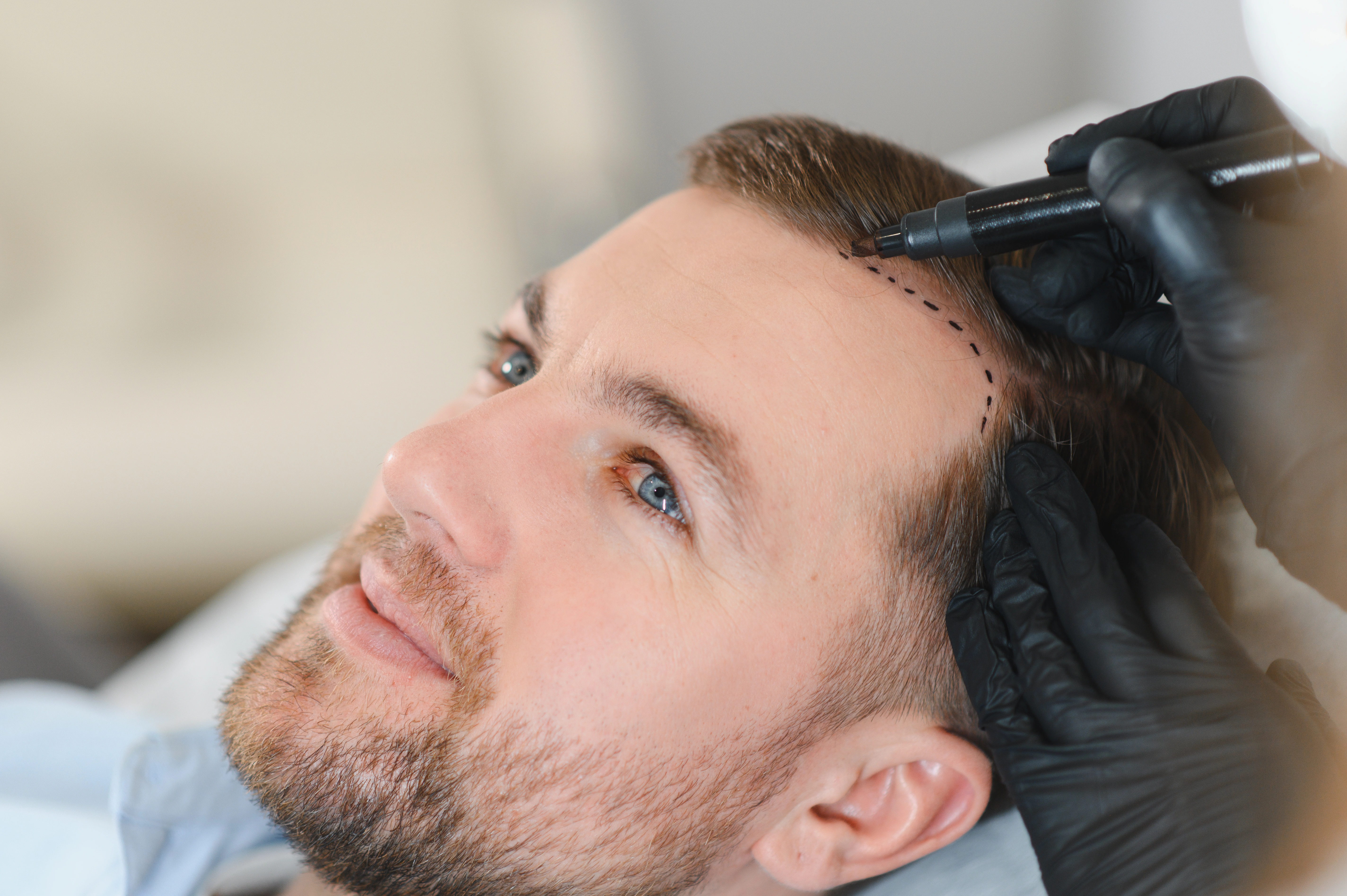
FUE (follicular unit extraction) harvests grafts one by one with a micro-punch, no linear strip scar, only small circular marks in the donor zone that fade over time. At DRFK we use conservative punch sizing, trichoscopy-backed density targets, and Turkish hairline design principles so your result looks natural in the long term, not over-harvested.
DRFK Turkish Medical Center is located at Villa 2, Al Athar Street, Jumeirah 3, Dubai. The clinic is easily accessible from Jumeirah, Umm Suqeim, Al Safa, Business Bay, and Downtown Dubai within around 15 minutes via Sheikh Zayed Road, with on-site parking available.
Occipital follicles are DHT-resistant but not unlimited. We cap daily extraction and session size to avoid moth-eaten donor thinning and to keep options for a second session if your hair loss progresses.
Norwood-pattern loss, hairline and crown goals, beard/eyebrow restoration, and many women with stable donor, after medical causes of diffuse loss are ruled out or treated when needed.
FUE (Follicular Unit Extraction) is a minimally invasive hair transplant method in which individual follicular units, groups of 1–4 hairs as they naturally grow, are extracted from the donor area using a micro-punch, then implanted into recipient channels in the balding zone. Unlike FUT (strip method), FUE leaves no linear scar, only tiny circular donor marks that become imperceptible within weeks.
The biological principle that makes FUE permanent: extracted follicles from the DHT-resistant donor area retain their genetic resistance after transplantation. They grow in the new location with the same permanence they had in the donor site.
Male pattern baldness (Norwood I–VI), receding hairline, crown baldness, diffuse hair thinning with adequate donor density, post-trauma or post-surgery scarring hair loss, eyebrow restoration, beard restoration. FUE is appropriate for the majority of hair loss presentations where donor density is adequate.
The donor area is a finite biological resource. The occipital and parietal scalp contains a determined number of DHT-resistant follicles, fixed at birth and decreasing with every transplant procedure. Responsible FUE planning extracts conservatively, protecting the donor area for future procedures as hair loss progresses over the patient's lifetime.
Overharvesting consequences: Visible donor thinning (moth-eaten appearance), loss of natural density gradient, insufficient grafts for future sessions. At DRFK, trichoscopy quantifies donor density objectively before any extraction target is agreed.
Safe extraction limits: Typically 30–40% of the visible donor follicular units per session, ensuring sufficient density remains for the donor area to appear normal and for future procedures.
FUE is the globally preferred standard. FUT (strip) produces a permanent linear scar; FUE leaves only dot scars that become imperceptible.
| FUE | FUT (Strip) | |
|---|---|---|
| Donor scar | Dot scars (imperceptible) | Linear scar (permanent) |
| Recovery | Faster | Slower |
| Donor area flexibility | All head areas accessible | Strip location only |
| Short hair wearability | Yes | No, scar visible |
| Revision potential | Higher | Lower |
| Technique preference | Global standard | Declining use |
Genetics (androgenetic alopecia) drives 95% of hair transplant presentations. DHT binds to androgen receptors in genetically sensitive follicles, triggering miniaturisation that reduces hair shaft diameter until the follicle ceases production. Hormonal changes, nutritional deficiency (iron, ferritin, zinc), and chronic stress are secondary causes, these must be addressed before FUE is performed.
| Assessment | Purpose |
|---|---|
| Norwood Scale Classification | Pattern severity, determines graft requirement and treatment priority |
| Trichoscopy | Donor density per cm², objective graft availability data |
| Scalp Mapping | Recipient zone prioritisation, hairline, mid-scalp, crown |
| Graft Count Calculation | Available vs required, realistic coverage outcome |
| Miniaturisation Ratio | Percentage of miniaturising follicles, predicts future loss trajectory |
| Blood Panel | Ferritin, iron, thyroid, testosterone, addresses treatable factors |
The donor area is shaved. Local anaesthesia is administered. Using a 0.6–0.9mm micro-punch, the surgeon scores around each follicular unit and extracts it with minimal surrounding tissue. Punch size is selected based on follicular unit size to minimise trauma and maximise graft integrity.
Graft integrity is critical: The graft must be extracted without transection (cutting the follicle in half). Transected follicles do not grow. The skill of the extraction team and the precision of the micro-punch directly determines graft survival rate.
Extracted grafts are placed in physiological preservation solution and sorted under microscope: single-hair grafts for the hairline edge, two-hair grafts for the mid-hairline, three-hair grafts for mid-scalp density.
Out-of-body time matters: The longer a graft remains outside the scalp, the lower its survival probability. At DRFK, extraction and implantation workflow is coordinated to minimise out-of-body time.
Before recipient channels are created, the hairline is designed using anatomical markers: Micro-irregular design (natural hairlines are not straight lines). Facial proportion analysis (hairline height set relative to brow and facial thirds). Temple point restoration. Age-appropriate placement (overly low hairline looks abnormal when surrounding hair thins further).
Channels are created in the recipient zone at the planned density, angle, and direction. Grafts are implanted with forceps or a Choi pen (DHI component). Each hair's natural growth direction is followed, producing hair that lies flat and grows in the correct orientation post-transplant.
| Step | What Happens |
|---|---|
| 01, Consultation | Norwood grading, trichoscopy, graft planning |
| 02, Pre-op | Blood panel, medication cessation, shaving |
| 03, Extraction | Micro-punch FUE donor harvesting under local anaesthesia |
| 04, Graft sorting | Microscope-guided follicular unit separation |
| 05, Hairline design | Anatomical marking, patient confirmation |
| 06, Channel creation + implantation | Angle-controlled, density-mapped |
| 07, Post-op | Written protocol, first wash at 48 hours, Day 10 review |
| Phase | Timeline | What to Expect |
|---|---|---|
| Immediate | Days 1–3 | Redness, scabbing, mild swelling at donor and recipient |
| Healing | Days 5–14 | Scabs shed; donor dots becoming imperceptible |
| Shock Loss | Weeks 2–8 | Transplanted hairs shed, follicles remain active |
| Early Regrowth | Months 3–4 | New fine hairs emerging from implanted follicles |
| Density Development | Months 4–6 | Coverage increasing visibly |
| Full Result | Months 9–12 | Final FUE density, complete transplant outcome |
Graft estimate, hairline design, and medical fitness before the operation day.
Sterile punch (commonly 0.7–0.9 mm class), team-based counting and storage in holding solution.
Angled slits for natural direction; dense packing only where blood supply allows.
Avoid smoking and nicotine for the full period your team recommends before and after surgery, both reduce graft survival and wound healing.
Bring a complete medication and supplement list (including blood thinners) and report any prior scalp surgery or medical scalp treatments at pre-assessment.
Plan social and work buffer time: visible redness or crusting in weeks 1–2 is normal; many patients schedule lighter commitments during early healing.
Every day: 9:00 AM – 6:00 PM
Villa 2 Al Athar Street, Jumeirah 3, Dubai, United Arab Emirates