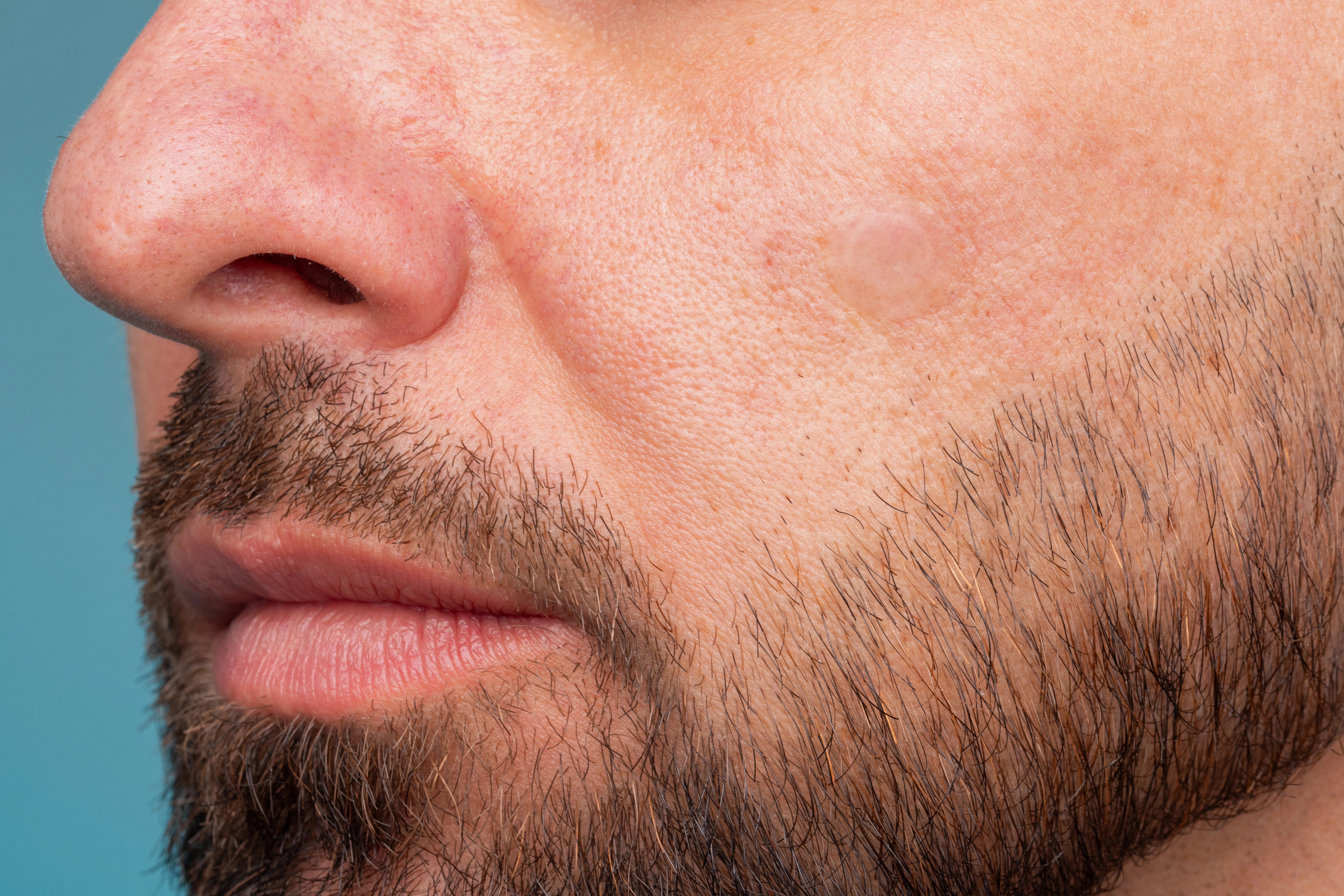
Beard density and border design with FUE or DHI at DRFK, angle, curl, and natural exit direction are planned on the face, not only on the scalp donor map. We protect occipital donor reserves for future needs and align graft numbers with realistic coverage goals for cheeks, goatee, or full-beard patterns.
DRFK Turkish Medical Center is located at Villa 2, Al Athar Street, Jumeirah 3, Dubai. The clinic is easily accessible from Jumeirah, Umm Suqeim, Al Safa, Business Bay, and Downtown Dubai within around 15 minutes via Sheikh Zayed Road, with on-site parking available.
We map density per zone (sideburn, cheek, chin, moustache connector) and discuss scar or alopecia patches from prior injury or surgery. Beard hair differs from scalp hair in calibre and behaviour, the surgical plan reflects that.
Facial restoration still draws from the same finite donor pool. Over-extraction risks moth-eaten density at the back, trichoscopy and a conservative upper limit are part of consent.
Beard hair transplant transfers DHT-resistant hair follicles from the occipital scalp donor area to the beard region, cheeks, jawline, chin, moustache, and sideburns, using FUE extraction and DHI or channel-based implantation. The transplanted follicles grow permanently in the facial skin, producing natural beard density that can be shaved, trimmed, and styled like native beard hair.
The critical technical requirement distinguishing beard transplant from scalp transplant is angle-controlled implantation, beard hair grows at 15°–45° angles specific to each facial zone. Incorrect angulation produces an unnatural, stiff-looking beard that does not flow correctly with the face.
Patchy beard growth: The most common presentation, irregular beard density from genetics producing isolated bald patches within otherwise beard-capable skin. Transplantation fills patches with DHT-resistant follicles matching surrounding native beard.
Absent facial hair: Patients with little or no natural beard growth. Full beard restoration requires 1,500–3,000+ grafts distributed across cheek lines, jawline, chin, and moustache.
Thin or sparse beard: Diffuse low-density beard, DHI technique achieves a results, achieving dense packing between existing follicles without disrupting them.
Scarred beard areas: Trauma, burns, surgery, or acne scarring destroying follicles in localised zones, correctable by transplanting grafts where vascular supply is adequate.
Goatee, moustache, or sideburn reconstruction: Isolated restoration of specific facial hair zones.
Genetics (androgen receptor distribution in facial skin) determines beard density, brothers and fathers with similar patterns confirm genetic causation. Hormonal insufficiency, low testosterone, is a less common but addressable cause requiring endocrinological assessment before transplant. Traction and scarring from acne or injury produce localised absent zones.
The defining difference between a natural beard transplant result and an obvious one is beard line architecture, the precise geometric design of cheek lines, jawline contour, chin definition, and moustache border relative to the patient's facial structure.
At DRFK, every beard transplant begins with facial geometry mapping: Cheek beard line (upper border relative to zygomatic arch). Jawline contour (following mandibular angle for masculine definition). Chin zone (goatee density and mentum coverage). Moustache integration (seamless connection to cheek beard). Sideburn connection (natural fade from scalp hair).
Graft guide: Patchy correction only: 500–1,000. Partial beard (chin + moustache): 800–1,500. Full cheek-to-jaw-to-chin beard: 2,000–3,500. Entire face including sideburns: 3,000–5,000.
| Assessment | Purpose |
|---|---|
| Facial Hair Density Analysis | Existing follicle count per cm² in beard zones, identifies absent vs sparse areas |
| Scalp Donor Evaluation | Occipital density and capacity, determines maximum safe graft extraction |
| Graft Requirement Calculation | Beard zone mapping: cheeks, chin, jaw, moustache, distribution plan |
| Beard Line Design Session | Facial proportion analysis, pre-agreed architecture before implantation begins |
| Skin Assessment | Facial skin quality, scarring extent, vascularity, graft survival probability |
Micro-punch follicular extraction from the occipital scalp, individual follicular unit harvesting at 0.6–0.9mm punch diameter. Grafts are implanted into pre-created channels at the correct angle and direction for each facial zone. Best for larger-area beard restoration where volume is the primary need. Duration: 4–8 hours | Day case | Desk Return: 5–7 days.
Choi implanter pen technique, simultaneous channel creation and graft implantation. Maximum angle control at 15°–45° specific to each beard zone's natural growth direction. Minimum out-of-body time, graft survival rate. Preferred for patchy beard treatment requiring precise, dense packing between existing beard follicles. Duration: 5–9 hours | Day case | Desk Return: 5–7 days.
FUE: Better for full beard restoration from minimal existing growth, large-area implantation where the recipient zone is largely empty.
DHI: Better for dense packing into partially existing beard, adding density between existing follicles without damaging them; beard line edge precision.
Hybrid: High-volume sessions may use FUE for bulk coverage with DHI precision for beard line edges, combining volume efficiency with edge artistry.
| Step | What Happens |
|---|---|
| 01, Consultation | Facial analysis, beard design mapping, graft calculation, technique selection |
| 02, Pre-Op | Donor area preparation; beard shave in recipient zone only (DHI allows unshaved surrounding) |
| 03, Extraction | FUE micro-punch extraction from occipital donor area under local anaesthesia |
| 04, Design Marking | Beard line architecture marked on face; patient confirms the design |
| 05, Implantation | Angle-controlled graft implantation at 15°–45° growth direction |
| 06, Post-Op | Written care protocol; first facial wash 48 hours; shaving after Week 10+ |
Shaving after beard transplant: No shaving for the first 10 weeks, allowing graft anchoring and initial growth establishment. First shave at Week 10–12 using electric razor (not blade) until Month 4. Full blade shaving from Month 4 onwards.
| Phase | Timeline | What to Expect |
|---|---|---|
| Healing | Days 1–5 | Redness, mild swelling, small scabs on beard area |
| Scab Resolution | Days 5–10 | Scabs shed naturally; early presentable appearance |
| Shock Loss | Weeks 2–8 | Transplanted beard hairs shed, normal; follicles remain active |
| Early Regrowth | Months 3–4 | Fine new beard hairs emerging |
| Density Development | Months 4–6 | Beard coverage improving significantly |
| Full Maturity | Months 9–12 | Complete beard density and texture matured |
Hormonal causes of poor beard growth are considered when relevant; no transplant replaces untreated endocrine issues.
Micro-punch extraction sized to graft calibre; grafts kept in controlled holding solution.
Low angle for natural lie; single session or staged by facial zone and graft count.
Avoid smoking and nicotine for the full period your team recommends before and after surgery, both reduce graft survival and wound healing.
Bring a complete medication and supplement list (including blood thinners) and report any prior scalp surgery or medical scalp treatments at pre-assessment.
Plan social and work buffer time: visible redness or crusting in weeks 1–2 is normal; many patients schedule lighter commitments during early healing.
Every day: 9:00 AM – 6:00 PM
Villa 2 Al Athar Street, Jumeirah 3, Dubai, United Arab Emirates